Project details
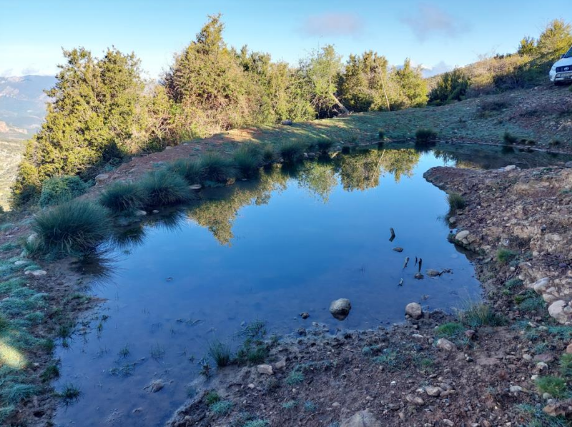
The Bionexus Foundation has carried out a research project on the aquatic fauna of mountain ponds in the Serra de Boumort. This project investigated the relationship between aquatic fauna, water permanence, and livestock pressure in mountain ponds. It also evaluated the potential of artificial mountain ponds to maintain aquatic biodiversity. This research is the result of doctoral thesis conducted by Dr. Lena Fehlinger, presented in 2026 in collaboration with the University of Vic - Central University of Catalonia.
The results of this project indicate that permanent ponds (which have water year-round) exhibit higher species richness and macroinvertebrate abundance. In contrast, temporary ponds (which only have water during specific times of the year) feature more specialized species adapted to water seasonality. However, size and altitude are also factors that can influence the biodiversity of these ponds.
Analyzing the impact of livestock, it was observed that ponds without livestock presence had greater species richness and abundance of macroinvertebrates and amphibians, as well as higher macrophyte coverage. To conduct the study, livestock was excluded from certain ponds using fencing that prevented cattle from accessing the ponds. Thus, the results demonstrate that fencing is an effective method for reducing the impact of livestock on mountain ponds.
Regarding the creation of artificial ponds to maintain biodiversity, new ponds were constructed and compared with natural ponds in the area. The findings indicated that artificial ponds hosted species found both in nearby natural ponds and from other locations, as the present species were primarily active dispersers capable of traveling long distances. This suggests that well-designed artificial ponds serve as complementary habitats and are therefore a suitable strategy for conserving aquatic biodiversity in mountain ponds.
Finally, the project included a literature review of scientific studies on mountain ponds across Europe. The search results show that while some regions are heavily studied (such as the Alps), mountain ranges like the Carpathians remain largely unexamined. At the organism level, most studies focus on macrofauna and flora. The main themes investigated are the effects of climate change and livestock farming on these ponds. Finally, many publications link mountain ponds to ecosystem services and their use as nature-based solutions.
Copyright © 2026 Bionexus.